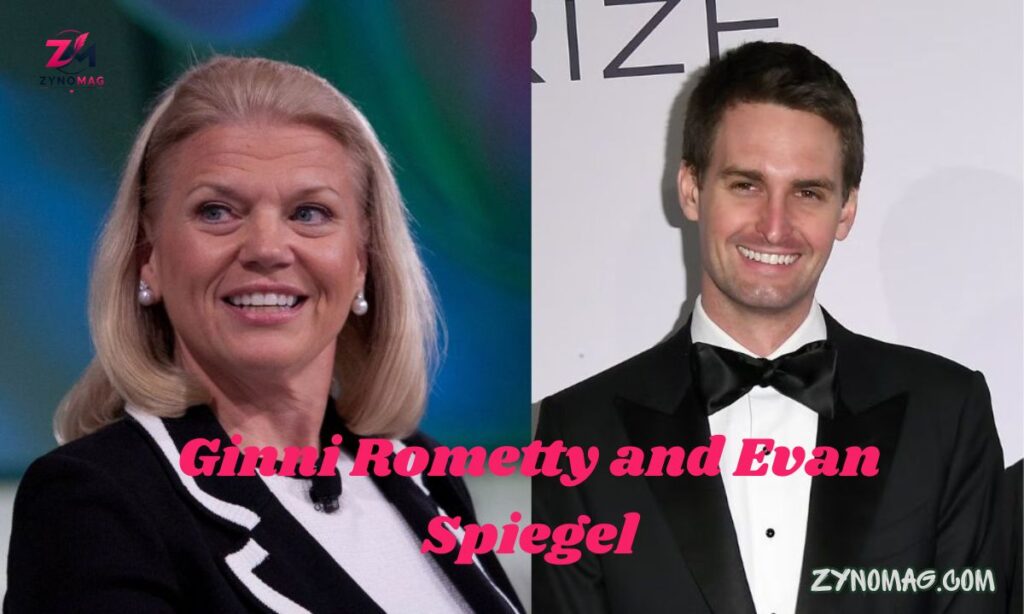

Ginni Rometty (born July 29, 1957) and Evan Spiegel (born June 4, 1990) are two of the most talked-about names in technology. They come from different generations and different worlds. Yet both reached the top of major tech companies. Rometty became the first woman to lead IBM. Spiegel co-founded Snapchat and took Snap Inc. public at a young age.
Their paths could not look more different. Rometty spent nearly four decades inside a 100-year-old company and reinvented it for cloud and AI. Spiegel built an app from a Stanford idea and is now betting on augmented reality glasses. This guide compares their careers, leadership styles, and lessons in simple terms.
Table of Contents
Ginni Rometty and Evan Spiegel Quick Bio Table
| Detail | Ginni Rometty | Evan Spiegel |
|---|---|---|
| Full name | Virginia M. Rometty | Evan Spiegel |
| Born | July 29, 1957, Chicago, Illinois | June 4, 1990, Los Angeles, California |
| Nationality | American | American |
| Education | Northwestern University, BS in computer science and electrical engineering | Stanford University, product design |
| Known for | First woman to serve as CEO of IBM | Co-founder and CEO of Snap Inc. |
| Company | IBM | Snap Inc. (Snapchat) |
| Top job | CEO from January 2012, retired December 31, 2020 | Co-founder and CEO since 2011 |
| Signature moves | Hybrid cloud, AI, Red Hat acquisition | Disappearing messages, Stories, Lenses, Specs |
| Giving and advocacy | OneTen, P-TECH, the book Good Power | Snap Foundation, Spiegel Family Fund |
The gap in age and background is wide. Yet both leaders shaped how millions of people use technology.
Who Is Ginni Rometty?
Ginni Rometty is an American business executive. She was the ninth chairman, president, and CEO of IBM. She became CEO in January 2012 and took the chairman role in October of that year.
She was born in Chicago and studied computer science and electrical engineering at Northwestern University. She graduated with high honors. Northwestern later gave her an honorary degree and she has served on its board of trustees.
Rometty joined IBM in 1981 as a systems engineer in Detroit. She did not start at the top. She moved through consulting, insurance, sales, and strategy roles over three decades.
After retiring from IBM in 2020, she kept working on workforce issues. She co-chairs OneTen, a coalition that aims to help one million Black Americans move into family-sustaining jobs. She also wrote a book called Good Power about leading with purpose.
Ginni Rometty’s Leadership at IBM
Rometty took charge when IBM was changing fast. Cloud computing, big data, and mobile tools were reshaping the market. Old hardware and services businesses were under pressure.
Her answer was a long reinvention. IBM shifted toward cloud, security, data, and artificial intelligence. Company materials say IBM reinvented about half of its portfolio during her tenure.
Here are the main moves that defined her leadership:
- Pushed IBM Watson and enterprise AI into real business use
- Built a hybrid cloud business valued at roughly $25 billion
- Completed about 65 acquisitions in nine years
- Led the 2019 purchase of Red Hat, the largest deal in IBM history
- Backed P-TECH, a school model that links high school, college, and jobs
- Worked with the Business Roundtable to rethink the purpose of the corporation
Before she became CEO, she also led the integration of PricewaterhouseCoopers Consulting. That deal created a global team of more than 100,000 consultants and was the largest in professional services history at the time.
Her record is not free of criticism. IBM reported years of falling revenue while it made the shift. Supporters say the change was necessary and hard. Critics say results came too slowly. Both views are part of an honest picture.
Who Is Evan Spiegel?
Evan Spiegel is the co-founder and CEO of Snap Inc. He was born and raised in Los Angeles. He studied at Stanford University, where the idea for Snapchat began. Spiegel and Bobby Murphy built the app while at Stanford. Reggie Brown was also part of the early story.

The idea was simple. Photos should disappear, just like a normal conversation fades. He became the youngest CEO of a newly public major U.S. tech company when Snap listed on the New York Stock Exchange in March 2017. The shares opened at $17.
Spiegel now leads both Snap Inc. and Specs Inc., a subsidiary focused on augmented reality eyewear. He also gives through the Spiegel Family Fund, which supports arts, education, housing, and human rights. He is married to model Miranda Kerr. They have been public about balancing family life with a demanding job.
Evan Spiegel and the Growth of Snapchat
Snapchat launched in 2011 as a photo sharing app. It grew first among teens and young adults. Disappearing messages felt more casual and less permanent than other social feeds. The product kept changing. Stories arrived in 2013 and let people share a day in a row of snaps.
Discover and creator content followed. Lenses in 2015 turned the camera into a playground. Spiegel is also known for saying no. Reports say he turned down a $3 billion offer from Facebook. That choice shaped the company as an independent brand.
Growth came with real struggles. The 2018 redesign upset many users. Ad revenue has faced pressure from larger rivals. Snap has also cut costs and restructured at different points.
Still, the numbers are large. Snap says it has more than 950 million monthly active users. It has also built subscription income through Snapchat+.
Here is a simple view of the Snapchat timeline:
- 2011: Snapchat launches
- 2013: Stories debuts
- 2015: Lenses and Discover arrive
- 2016: Spectacles camera glasses appear
- 2017: Snap goes public on the NYSE
Evan Spiegel’s Interest in Augmented Reality
Spiegel believes the future of computing sits in front of our eyes, not in our pockets. This belief drives most of Snap’s long-term spending. Snapchat Lenses were the first big step. They taught millions of people to place digital effects on the real world.
Spectacles followed in 2016 as a camera in a pair of glasses. Snap has since moved toward full augmented reality glasses called Specs. The company has said consumer Specs are planned for 2026. They are meant to blend digital content with the physical world.
Spiegel has been clear about the goal. He says Specs should not copy phone apps into glasses. He wants AI to sit at the core of the experience. Competition is strong. Meta, Google, Samsung, and Apple are all working on their own smart glasses and mixed reality devices.
Ginni Rometty and Evan Spiegel: Comparing Their Leadership Styles
Both leaders think long term. They differ in how they get there. Rometty led through large systems, partnerships, and acquisitions. Spiegel leads through product taste and a single clear vision.
Rometty ran a company with hundreds of thousands of employees across 170 markets. She had to guide change through many layers. Her style leaned on listening, coalitions, and steady communication.
Spiegel runs a younger and smaller company. He stays close to design and product choices. He is known for strong opinions about how Snapchat should look and feel.
| Area | Ginni Rometty | Evan Spiegel |
|---|---|---|
| Starting point | Joined a mature company as an engineer | Founded the company as a student |
| Main method | Acquisitions, partnerships, reinvention | Product design and new formats |
| Time horizon | Multi-year transformation of a legacy firm | Bet on a new computing platform |
| Focus | Enterprise customers and business trust | Consumers, creators, and developers |
| Public voice | Policy, workforce, corporate purpose | Product launches, annual letters |
| Biggest risk | Slow revenue during the shift | Heavy spending on hardware |
The table shows two valid ways to lead. One works from inside a giant. The other works from a blank page.
The Influence of Ginni Rometty and Evan Spiegel on the Technology Industry
Rometty helped prove that a very old tech company can reinvent itself. IBM leaned into hybrid cloud and AI before many peers did. Red Hat gave IBM a strong open source base. She also pushed a wider view of talent. P-TECH and OneTen argue that skills matter as much as degrees.
Many employers now talk about skills-based hiring, and her work helped bring that idea into the mainstream. Spiegel’s influence is different. He changed how people share. Disappearing content, Stories, and camera-first design spread far beyond Snapchat.
Many other platforms copied them. He also pushed augmented reality into everyday use. Lenses made AR normal for a global audience long before most people owned a headset.
Here is a short list of lasting effects:
- Rometty: enterprise AI, hybrid cloud, skills-first hiring, corporate purpose
- Spiegel: ephemeral messaging, Stories format, mobile AR, camera-first apps
- Both: proof that clear strategy can survive tough market cycles
Lessons From Their Professional Journeys
Their careers look nothing alike. Even so, the lessons overlap in useful ways. First, patience matters. Rometty spent decades learning IBM before she led it. Spiegel stayed with one idea for more than ten years.
Second, big bets need conviction. Rometty chose Red Hat. Spiegel chose AR glasses. Neither bet was safe. Third, criticism does not end a career. Both leaders faced doubt about revenue and direction. Both kept working on their long-term plans.
| Lesson | Example from Rometty | Example from Spiegel |
|---|---|---|
| Play the long game | Reinvention of IBM over nine years | Decade-long push into AR |
| Make bold deals | Red Hat acquisition | Declining a $3 billion offer |
| Stay open to change | Moved IBM toward cloud and AI | Reworked the Snapchat experience |
| Build the next generation | P-TECH and OneTen | Snap Foundation programs |
Ginni Rometty’s Career and Major Achievements
Rometty’s career spans more than 39 years at one company. She began in 1981 and retired at the end of 2020. Few leaders stay that long in modern tech.
Her path moved through clear stages:
- Systems engineer in Detroit
- Leader in consulting and insurance solutions
- Head of IBM Global Business Services, where she led the PwC Consulting integration
- Senior vice president for sales, marketing, and strategy
- CEO from 2012 and chairman from 2012
- Executive chairman until her retirement
Her major achievements include:
- Becoming the first woman to lead IBM
- Guiding IBM into AI, hybrid cloud, security, and quantum computing
- Closing the Red Hat deal in 2019
- Winning the Carl Sloane Award in 2006 for leadership in professional services
- Helping expand P-TECH across more than twenty-eight countries
- Co-chairing OneTen and writing Good Power
Her board and advisory roles continue to grow. They include work with Northwestern University and international advisory councils.
Evan Spiegel’s Career and Business Success
Spiegel’s career is shorter but faster. He went from student to CEO of a public company in about six years. Snap’s IPO in 2017 made him a billionaire and the youngest CEO of a newly public major U.S. tech firm. It also put him under constant pressure from investors.
He has focused on products people actually use each day. Snapchat now sits among the most used apps for younger audiences. Snapchat+ shows that paid features can add steady income.
His key achievements include:
- Co-founding Snapchat and building it into a global platform
- Introducing Stories and Lenses, formats now common across social media
- Taking Snap public in 2017
- Launching Spectacles and leading the move toward Specs
- Starting the Spiegel Family Fund and the Snap Foundation
- Co-founding the Department of Angels after the 2025 Los Angeles wildfires
Spiegel also serves on the boards of the Berggruen Institute and Crossroads School for Arts and Sciences. He is a member of the Business Roundtable.
Are Ginni Rometty and Evan Spiegel Related?
No. Ginni Rometty and Evan Spiegel are not related. Public biographies show no family link between them. They belong to different generations and different industries. Rometty built a career in enterprise technology.

Spiegel built a consumer app company. Their names appear together because people compare tech leaders of different eras. They have shared some public circles. Both have connections to business groups such as the Business Roundtable.
That is a professional link and nothing more. If you see a claim of a family tie, treat it with caution. Check it against official biographies before you trust it.
Ginni Rometty and Evan Spiegel’s Approach to Education
Education shaped both leaders, but in very different ways. Rometty followed the classic path. Spiegel used school as a place to start something.
Rometty studied computer science and electrical engineering at Northwestern. That technical base helped her start as an engineer and later speak with clients about hard problems. She later became a strong voice for skills-based hiring.
Spiegel found the idea for Snapchat in a Stanford product design setting. School gave him a team, a lab, and a network. The degree mattered less than the problem he chose to solve.
| Topic | Ginni Rometty | Evan Spiegel |
|---|---|---|
| University | Northwestern University | Stanford University |
| Field | Computer science and electrical engineering | Product design |
| School role | Technical foundation for a corporate career | Launchpad for a startup |
| Education giving | P-TECH, OneTen, Northwestern board service | Snap Foundation, Spiegel Family Fund, school board service |
Both now invest in education for others. Rometty focuses on pathways into good jobs. Spiegel supports creative economy access for young people in Los Angeles.
What Can Business Professionals Learn From Ginni Rometty and Evan Spiegel?
You do not need to run a huge company to use their lessons. These ideas work for managers, founders, and creators.
Here are practical takeaways:
- Reinvent before you are forced to. IBM changed its portfolio while it was still strong. Waiting costs more.
- Own a clear vision. Spiegel explains where Snap is going and why. Teams follow clarity.
- Invest in people. Rometty linked business success to skills, training, and fair hiring.
- Expect criticism. Both leaders faced doubt and kept to their plans while adjusting details.
- Make bold moves with care. Red Hat and Specs are big bets. Each needed deep research and strong partners.
- Give back. Both use their success to fund education and community work.
A good habit is to write down your own long-term bet. Then list what you can test this quarter. That is how large strategies become daily action.
You can also borrow their mix of styles. Use Rometty’s patience for systems and partnerships. Use Spiegel’s sharp focus on product and user experience.
Frequently Asked Questions
Who is Ginni Rometty?
Ginni Rometty is the former chairman, president, and CEO of IBM. She was the first woman to lead the company.
Who is Evan Spiegel?
Evan Spiegel is the co-founder and CEO of Snap Inc., the company behind Snapchat. He started the app while studying at Stanford University.
Are Ginni Rometty and Evan Spiegel related?
No. They are not related and have different backgrounds, careers, and industries.
What did Ginni Rometty achieve at IBM?
She led IBM into hybrid cloud and AI and closed the Red Hat acquisition in 2019. She also backed P-TECH and workforce programs.
What is Evan Spiegel best known for?
He is best known for Snapchat, disappearing messages, Stories, and Lenses. He is also leading Snap’s move into augmented reality glasses.
Why is Evan Spiegel interested in augmented reality?
He believes AR and AI will shape the next era of computing. Snap’s Specs glasses are built around that idea.
What can leaders learn from Ginni Rometty and Evan Spiegel?
They show the value of long-term vision, bold bets, and investing in people. Their paths prove there is more than one way to lead in tech.
Final Thoughts
Ginni Rometty and Evan Spiegel show two real routes to technology leadership. One route runs through decades of steady growth inside a legacy company. The other runs through a bold product idea and a founder’s focus.
The common thread is conviction. Both leaders made big bets, faced criticism, and kept working on the future. Their records are not perfect, but their influence on cloud, AI, social media, and augmented reality is clear.
If you lead a team, take one idea from each. Plan for change like Rometty. Build with focus like Spiegel. Then give your people the skills and room to grow.