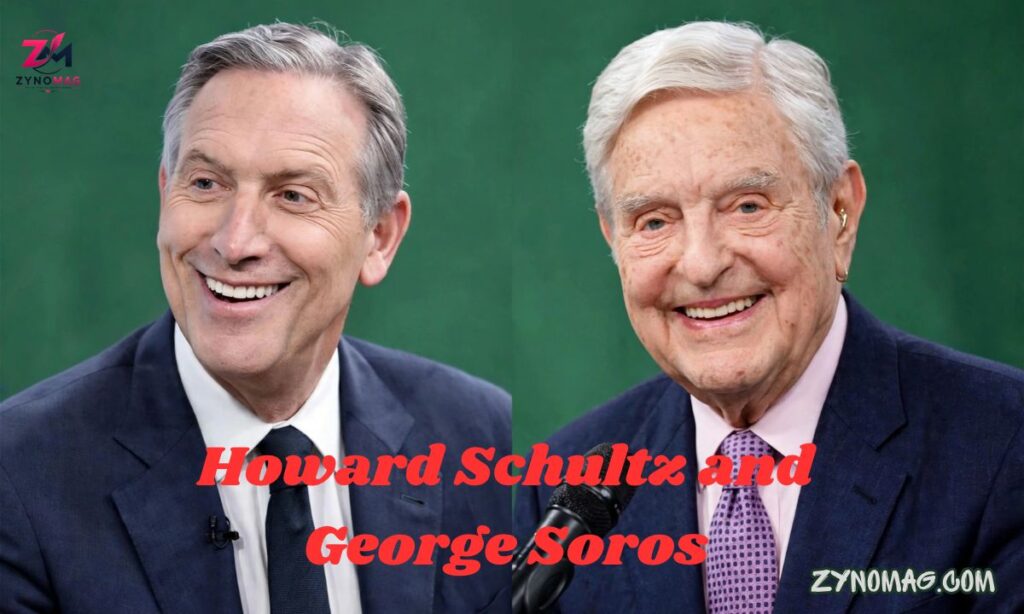

Howard Schultz was born on July 19, 1953, in Brooklyn, New York. He grew up in public housing and later turned Starbucks into a global coffee brand. George Soros was born on August 12, 1930, in Budapest, Hungary. He became a famous hedge fund manager and later gave billions through the Open Society Foundations.
Their careers look very different, but their names often appear together in search results. So what connects Howard Schultz and George Soros? Public records show no business partnership between them. The documented link is political.
Soros has donated to American Bridge 21st Century, a Democratic research group. That group filed a federal complaint against Schultz in 2019, when he was exploring an independent run for president. This guide covers their careers, their politics, and what the evidence actually shows.
Table of Contents
Howard Schultz and George Soros Bio
| Detail | Howard Schultz | George Soros |
| Full name | Howard D. Schultz | George Soros (born György Schwartz) |
| Born | July 19, 1953, Brooklyn, New York | August 12, 1930, Budapest, Hungary |
| Nationality | American | Hungarian-American |
| Education | Northern Michigan University | London School of Economics (philosophy, BSc 1951, MSc 1954) |
| Profession | Businessman, former Starbucks CEO | Hedge fund manager, philanthropist |
| Known for | Growing Starbucks into a global brand | Quantum Fund, 1992 Black Wednesday trade, Open Society Foundations |
| Key roles | Starbucks CEO (two stretches), interim CEO 2022 to 2023 | Founder of Soros Fund Management (1970), Open Society Foundations (1993) |
| Philanthropy | Schultz Family Foundation (veterans, youth jobs) | Open Society Foundations (more than $32 billion donated as of October 2023) |
| Net worth (last reported) | About $4.3 billion (Forbes, October 2020) | About $6.7 billion (October 2023) |
| Political link | Explored an independent presidential run, ended September 6, 2019 | Documented donor to American Bridge 21st Century |
Who Is Howard Schultz?
Howard Schultz is an American businessman. He is best known for turning Starbucks from a small Seattle coffee seller into a worldwide chain. He led the company in two long stretches and returned as interim CEO in 2022.
He also owned the Seattle SuperSonics basketball team from 2001 to 2006. Later he started the Schultz Family Foundation, which works on youth unemployment and support for military veterans.
Early Life and Education
Schultz was born on July 19, 1953, in Brooklyn, New York. He grew up in the Canarsie public housing projects. His father, Fred, was a truck driver. Schultz has described his family as poor. Some childhood contemporaries recall a more middle-class home.
Both versions appear in biographies, so it is fair to note the difference. One event shaped him. When he was seven, his father broke an ankle. The family had no health insurance and no income for a time. Schultz has pointed back to that moment when explaining his later views on employee benefits.
He went on to college and then into sales. One of his jobs was at Hammarplast, a company that sold European coffee makers in the United States. A spike in coffee maker orders from a small Seattle shop led him to Starbucks.
Building a Global Coffee Business
Schultz joined Starbucks in 1982 at age 29. His title was director of retail operations and marketing. At that time the company sold mainly whole beans.
He left in 1985 to open his own coffee bar. Fundraising was hard. Of the 242 investors he approached, 217 turned him down. He later brought the Starbucks name back under his own control and grew it rapidly.
The table below shows the main steps in his Starbucks career.
| Period | Milestone |
|---|---|
| 1982 | Joins Starbucks in retail operations and marketing |
| 1985 | Leaves to start his own coffee bar |
| 2008 | Returns as CEO during the financial crisis |
| 2017 | Kevin Johnson succeeds him as CEO |
| 2018 | Steps down as chairman |
| 2022 to 2023 | Serves as interim CEO, then leaves early in March 2023 |
His 2008 return was not painless. During that period the company closed hundreds of stores and cut jobs. Supporters call it a rescue. Critics call it a hard reset that cost workers their positions. Both views are part of the record.
Leadership and Employee Benefits
Schultz is widely linked to the idea that a coffee chain should treat workers as owners. Starbucks calls its employees “partners.” The company built several well-known benefits during his leadership.
- Health coverage for part-time staff. Schultz told a U.S. Senate committee in 2023 that Starbucks began this in 1988. Some other sources date it to 1987.
- Bean Stock. Since 1991, eligible full-time and part-time partners have received equity in the form of stock.
- College Achievement Plan. Launched in 2014 with Arizona State University, it offers tuition coverage for online degrees.
These programs earned Starbucks praise from many business writers. They also raised the bar for retail employers. Still, the story is not one-sided. Labor groups have challenged Starbucks over scheduling, pay, and union organizing in later years. A balanced reader should hold both the benefits record and the criticism in mind.
Who Is George Soros?
George Soros is a Hungarian-American investor and philanthropist. He was born György Schwartz in Budapest on August 12, 1930. His family changed the surname to Soros in 1936 as protection in an increasingly hostile Hungary.
He was 13 in March 1944 when Nazi Germany occupied Hungary. His family survived by using false identities and hiding. Soros later described that period as a lesson in how fragile social order can be.
At 17 he moved to England. He studied philosophy at the London School of Economics and earned a bachelor’s degree in 1951 and a master’s in 1954. There he studied under the philosopher Karl Popper, whose ideas about open and closed societies stayed with him for life.
Career in Finance
Soros began as an arbitrage trader and analyst. He later moved to Wertheim & Co. in New York. In 1970 he founded Soros Fund Management with investor Jim Rogers. Its flagship vehicle became the Quantum Fund.
His best-known trade came in 1992. During the Black Wednesday currency crisis, he bet against the British pound. Reports put his profit at about $1 billion. The press began calling him “the man who broke the Bank of England.” Not every call worked.
Even supporters note that some of his investments lost money. His long-term record, however, made him one of the best-known fund managers in the world. He also wrote about markets. His book The Alchemy of Finance explains his theory of reflexivity, the idea that investor beliefs can change the very prices they try to predict.
Philanthropy and the Open Society Foundations
Soros is now better known for his giving than for his trading. The Open Society Foundations, which he founded in 1993, support work in education, human rights, public health, and independent media across many countries.
As of October 2023, reference sources say he had donated more than $32 billion to the foundations. That figure is large enough that Forbes called him the most generous giver in terms of share of net worth in 2020. His son, Alex Soros, became chairman in 2023.
He also funded Central European University in Budapest. That gift became one of the largest education endowments in Europe. Politics is the other half of his public life. In the 2004 U.S. election he spent an estimated $20 million or more trying to defeat President George W. Bush.
The table compares them side by side.
| Feature | Howard Schultz | George Soros |
|---|---|---|
| Born | 1953, Brooklyn, New York | 1930, Budapest, Hungary |
| Main field | Retail and consumer brands | Hedge funds and investing |
| Signature work | Growing Starbucks worldwide | Quantum Fund and Soros Fund Management |
| Philanthropy | Schultz Family Foundation | Open Society Foundations |
| Best-known milestone | Starbucks expansion and benefits programs | 1992 bet against the British pound |
| Political posture | Self-described lifelong Democrat who explored an independent run | Longtime major donor to Democratic groups |
Business Leadership Versus Financial Investment
Schultz managed people, stores, and supply chains. His success depended on brand, culture, and daily operations. A bad quarter meant fixing coffee, service, or pricing. Soros managed risk. His success depended on reading markets and moving quickly.
His craft was timing and conviction, not store management. That difference shapes how each man is judged. Schultz is measured by jobs, growth, and workplace conditions. Soros is measured by returns, market impact, and how he later used his wealth.
Different Approaches to Social Impact
Schultz tended to work through his company and a family foundation. His signature social projects, such as health coverage, stock grants, and tuition help, were tied to Starbucks. His foundation later focused on veterans and young people seeking work.
Soros works through a global grant network. The Open Society Foundations fund causes in dozens of countries, and Soros also gives directly to political groups. In short, Schultz applied his ideas inside a company. Soros applied his ideas across institutions and borders.
Who Howard Schultz and George Soros Are
Search results often reduce both men to one-line labels. A short, accurate profile of each helps. These snapshots add detail not covered above.
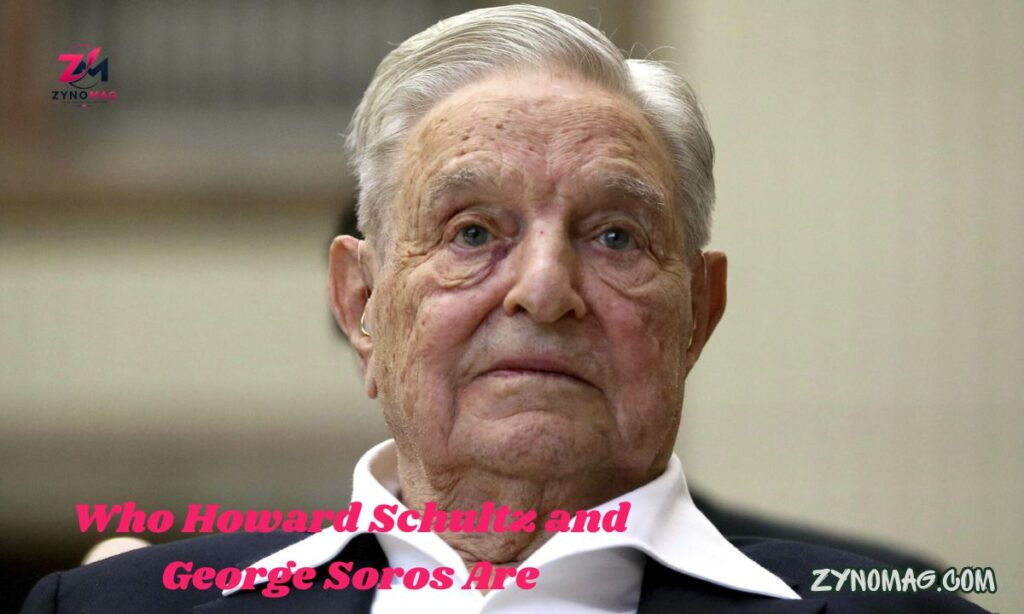
Howard Schultz: From the Brooklyn Housing Projects to the Top of Starbucks
Schultz’s story is one of upward mobility. He started in public housing and ended up running a company known around the world. Along the way he published several books on business and leadership.
He also flirted with public office. He publicly considered running for president in several election cycles, and in 2019 he came closest. That decision became the first half of the political story discussed later in this article.
George Soros: From Wartime Budapest to the Quantum Fund
Soros’s story is one of survival and reinvention. A childhood marked by occupation led to a career in global finance. He spoke Esperanto from boyhood, a language his father taught him, and the name Soros itself has a meaning in that language.
His later life has been shaped by one theme: the open society. He has argued that societies do best when they allow criticism, free inquiry, and the right to change leaders peacefully. His critics disagree with his methods and priorities, which is normal in politics.
Howard Schultz and George Soros in Checked Facts
Because this topic attracts rumors, it helps to check each claim. The table below separates what public records support from what they do not.
| Claim | What the record shows |
|---|---|
| Schultz and Soros are business partners | No evidence found of any joint company or investment |
| Soros has funded American Bridge 21st Century | Supported. FEC records cited by Ballotpedia show at least $4 million from 2012 to March 2016 |
| American Bridge filed a complaint about Schultz | Supported. FEC matter MUR 7567 lists American Bridge as complainant |
| The FEC punished Schultz | Not supported. The agency closed the file in November 2021 |
| Soros personally ordered the complaint | Not established in any source reviewed |
| Schultz ran for president | Partly true. He explored an independent bid and ended it on September 6, 2019 |
The table shows a pattern. The documented facts are narrower than the rumors. That gap is the main reason careful sourcing matters.
What Connects Howard Schultz and George Soros
Three things connect them in a verifiable way. First, both are billionaires with national profiles. Second, both have been active in American public life, one through business and the other through donations.
Third, and most important, Soros has been a donor to American Bridge 21st Century. That group later filed an election-law complaint about Schultz. The link is indirect, but it is real, and it explains why the names appear together.
Where Howard Schultz and George Soros Part Company
They split on fields, methods, and politics. Schultz worked in retail and brand building. Soros worked in finance. Schultz said he wanted to reform the two-party system from the center. Soros has directed money toward Democratic groups.
They also differ in how they use wealth. Schultz’s public record centers on Starbucks benefits and a family foundation. Soros’s centers on a large grant-making network and political giving.
The 2019 episode shows the divide most clearly. Schultz wanted a path outside the parties. A group funded in part by Soros argued that his activity had already made him a candidate under federal law.
The Documented Political Connection
The political connection involves three parts: Schultz’s flirtation with a presidential run, the group that challenged him, and a donor relationship that dates back years. Each part is documented separately. Joining them requires care.
Schultz’s Consideration of a Presidential Campaign
In January 2019, Schultz said he was exploring an independent presidential run. He described himself as a centrist and told CBS News’s 60 Minutes that he was not in bed with a party. He also called himself a lifelong Democrat.
The announcement drew a harsh response from Democratic activists. Many feared an independent candidate would split the vote and make it easier for President Donald Trump to win re-election. Schultz paused in June 2019, citing health concerns. He later cited a back injury that required three surgeries.
On September 6, 2019, he posted a letter ending the idea. He wrote that an independent campaign was not the best way to serve the country. He also said that many people feared a third-party run would help re-elect what he called a uniquely dangerous incumbent. He added that ballot deadlines made the path risky.
American Bridge 21st Century and the Complaint
American Bridge 21st Century is a liberal super PAC and research organization. It was founded in November 2010 by David Brock. It focuses on opposition research that helps Democrats. Today its political committee is listed with the FEC as AB PAC.
Soros has given to the group repeatedly. In the 2012 cycle, FactCheck.org described him as its largest donor with $1 million. Ballotpedia, citing FEC records, says he gave at least $4 million between 2012 and March 2016.
In February 2019, American Bridge and its leader, Bradley Beychok, filed a complaint with the Federal Election Commission. The case is known as MUR 7567. It alleged that Schultz had become a federal candidate through his public activity. It also said he had failed to register and report as one, as federal law requires.
Schultz responded in April 2019. The FEC’s commissioners split three to three on several motions in the case. In November 2021, the agency told the complainant it had dismissed the allegation and closed the file.
What the Evidence Establishes
The public record supports several points.
- Soros is a documented donor to American Bridge 21st Century.
- American Bridge filed an FEC complaint against Schultz in 2019.
- Schultz ended his independent exploration in September 2019.
- The FEC closed the matter in 2021 without penalizing him.
The sources reviewed do not establish other points.
- They do not show that Soros personally directed or knew about the complaint.
- They do not show a direct relationship between Schultz and Soros.
- They do not show any wrongdoing by Schultz.
Donors give to organizations. A donation alone does not prove control over each decision that organization makes. That is an important limit on what anyone can honestly claim.
Public Influence, Wealth, and Accountability
Wealth brings influence, and influence invites scrutiny. Both Schultz and Soros have faced it. A fair look at them should cover how each uses power and how each answers to the public. The point is not to praise or condemn either man. It is to understand the channels of influence and the evidence behind public claims.
Corporate Influence
Schultz’s influence came through a company. Starbucks set standards for workplace benefits in retail and shaped how Americans buy coffee. It also became a target for critics of corporate power and of labor practices.
That is normal for any large employer. Shareholders, regulators, workers, and customers all hold some leverage. In 2023, Schultz testified before the Senate HELP Committee and defended the company’s benefits record while senators questioned its labor practices.
Philanthropic and Political Influence
Soros’s influence flows through philanthropy and political giving. Open Society grants reach universities, media groups, and advocacy organizations around the world. Political donations, including those to American Bridge, add a partisan layer.
Supporters see this as civic engagement and a way to hold officials accountable. Critics argue that one billionaire should not shape politics so heavily. Both arguments are common in the debate over large donors on any side.
Campaign finance rules allow wide giving to super PACs and require disclosure. That disclosure is how the public learned about these donations.
Why Evidence Matters
Soros is often named in online claims that go far beyond the facts. Reference sources note that many conspiracy theories about him have been described by observers as antisemitic. That is a strong reason to rely on primary records.
Useful sources include FEC case files, court records, company filings, and major news reports. Claims that cannot be traced to such records deserve doubt.
A simple checklist helps readers.
- Find the original document, not a screenshot or summary.
- Check the date, because older facts may have changed.
- Separate what a person did from what others say they did.
- Look for a second, independent source.
Frequently Asked Questions
Who is Howard Schultz?
Howard Schultz is the former CEO of Starbucks who helped grow it into a global brand. He also explored an independent presidential run in 2019.
Who is George Soros?
George Soros is a Hungarian-American investor and philanthropist. He founded the Quantum Fund and the Open Society Foundations.
Are Howard Schultz and George Soros connected?
Not directly, as far as public records show. The documented link is that Soros donated to American Bridge, which filed an FEC complaint against Schultz in 2019.
Did Howard Schultz run for president?
No. He explored an independent bid in 2019 but announced on September 6, 2019, that he would not run.
What is American Bridge 21st Century?
It is a Democratic-aligned super PAC and research group founded in 2010 by David Brock. Its political committee is now listed as AB PAC.
Did the FEC find that Howard Schultz broke the law?
No. The FEC closed the complaint in November 2021 and dismissed the allegation.
How much has George Soros given to charity?
As of October 2023, reference sources say he had donated more than $32 billion to the Open Society Foundations.
Final Thoughts
Howard Schultz and George Soros come from very different worlds. One grew up in Brooklyn public housing and built a coffee empire. The other survived wartime Budapest and built a financial one. Their paths crossed only indirectly, through a political group and a federal complaint.
The lesson is simple. Stick to documents. The record shows a donor link, a complaint, and a closed case. It does not show a secret partnership or a direct order. Readers who respect that line will be better informed than those who chase rumors.