Gene Hackman and Pope Francis lived two very different lives. Gene Hackman was born on January 30, 1930, in San Bernardino, California. He became a two-time Oscar-winning actor known for The French Connection and Unforgiven.
Pope Francis was born Jorge Mario Bergoglio on December 17, 1936, in Buenos Aires, Argentina. He became the first Jesuit and first Latin American pope. Both men passed away in 2025.
Gene Hackman died around February 18 at age 95, and Pope Francis died on April 21 at age 88. This guide covers their early life, key career moments, and lasting legacies in simple steps. It also answers common questions, including whether the two men were ever connected.
Table of Contents
Gene Hackman and Pope Francis Bio
People often search for these two names together because both passed away in 2025. Their lives had little in common on paper. Yet each one earned worldwide respect in his own field.
The table below gives a quick snapshot before we go deeper.
| Detail | Gene Hackman | Pope Francis |
| Birth name | Eugene Allen Hackman | Jorge Mario Bergoglio |
| Born | January 30, 1930, San Bernardino, California | December 17, 1936, Buenos Aires, Argentina |
| Known for | Film acting | Leading the Catholic Church (2013 to 2025) |
| Best known for | The French Connection, Unforgiven | First Jesuit and first Latin American pope |
| Died | Around February 18, 2025, aged 95 | April 21, 2025, aged 88 |
| Cause of death (official statements) | Heart disease, with Alzheimer’s disease as a contributing factor | Stroke followed by irreversible heart failure |
Who Were Gene Hackman and Pope Francis?
Gene Hackman was a two-time Oscar-winning American actor. He worked for about four decades and played cops, villains, coaches, and fathers with equal skill. Pope Francis was the 266th pope of the Roman Catholic Church.
He led the Church for twelve years, from March 2013 until his death in April 2025. One man worked in front of cameras. The other worked in front of crowds, prisoners, refugees, and world leaders. Both became famous for being believable.
Gene Hackman: An Acclaimed American Actor
Hackman was never the classic leading man. He did not have a movie-star look, and he never pretended to. That is exactly why audiences trusted him.
He moved easily between drama, thriller, comedy, and action. Critics often called him one of the most versatile actors of New Hollywood.
Key facts about his career:
- Five Academy Award nominations and two wins
- Roles in more than seventy films
- Famous parts include Popeye Doyle, Lex Luthor, and Norman Dale in Hoosiers
- Retired from acting after the 2004 film Welcome to Mooseport
Pope Francis: A Religious Leader From Argentina
Jorge Mario Bergoglio grew up in Buenos Aires in a family of Italian immigrants. He became a Jesuit priest, then a bishop, then a cardinal.
In 2013 the cardinals elected him pope. He chose the name Francis after Saint Francis of Assisi, the saint linked with poverty and care for creation. He was the first pope from the Americas. He was also the first Jesuit to hold the office.
What Gene Hackman and Pope Francis Had in Common
On the surface, a Hollywood actor and a pope share almost nothing. Look closer and a few patterns appear. These are patterns in how both men worked and how the public saw them, not claims about any personal link.
Dedication to Their Work
Hackman treated acting as a craft. Colleagues often described him as prepared, direct, and serious about the job. He also took roles that did not flatter him, which showed commitment to the story over his image.
Francis kept a heavy schedule well into his late eighties. He travelled to dozens of countries, wrote major documents, and kept meeting people even while his health was failing. Both men worked until late in life, and both gave their fields real discipline.
Different Ways of Understanding Human Nature
Hackman explored human nature through performance. His characters were often flawed, angry, funny, or lonely. He made viewers see that good and bad can live in the same person.
Francis explored human nature through faith and pastoral care. He spoke often about mercy, forgiveness, and the dignity of ordinary people. He liked to say that the Church should meet people where they are.
One used fiction. The other used scripture and conversation. Both were interested in the same question: what makes people act the way they do?
Influence Beyond Their Professions
The influence of both men reached past their jobs. Hackman’s style shaped how many later actors approached realism on screen. Younger performers still point to his natural, unforced acting.
Francis shaped talks on migration, poverty, climate change, and peace. Leaders who disagreed with him still listened to him.
| Area | Gene Hackman | Pope Francis |
| Main platform | Cinema | The Catholic Church and global diplomacy |
| Style | Realistic, grounded, intense | Humble, direct, pastoral |
| Public image | Serious craftsman | Pope of the poor |
| Lasting impact | Modern screen acting | Church reform and moral voice |
Gene Hackman Early Life and Path to Acting
Eugene Allen Hackman was born on January 30, 1930, in San Bernardino, California. His family moved around during his childhood, and he spent part of his youth in Danville, Illinois.
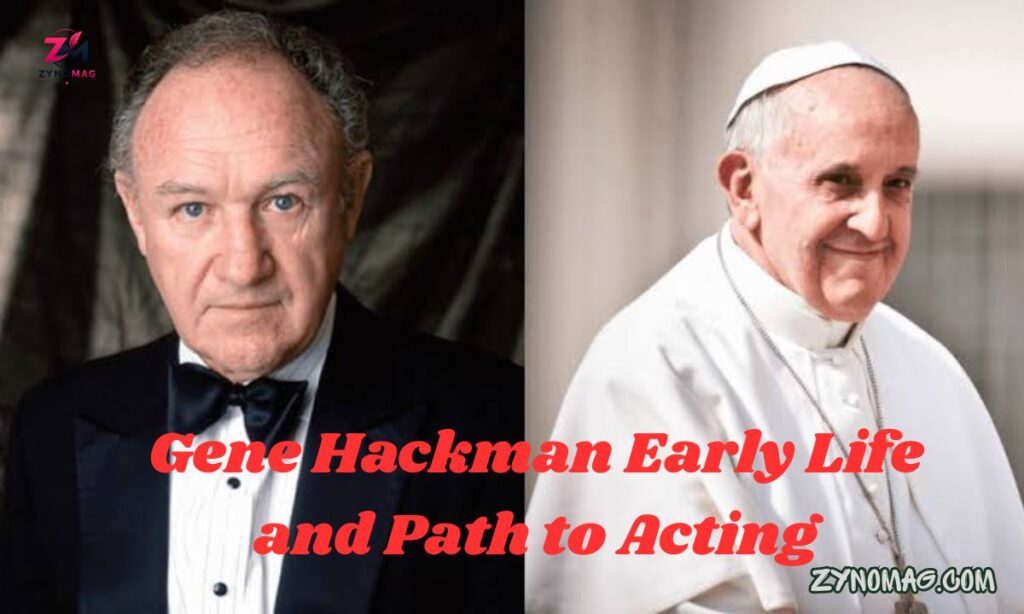
His father left the family when Hackman was a teenager. Hackman later joined the United States Marine Corps at the age of sixteen after giving a false age. He served for several years in the Pacific region and then returned to civilian life.
After the military, he tried several jobs and studied journalism and television production for a short time. Acting was not an obvious path for him. Still, the pull of the stage grew stronger.
He trained at the Pasadena Playhouse in California. There he met other young actors, including Dustin Hoffman. Accounts of those years say that classmates once voted him the least likely to succeed.
His early years show a simple pattern:
- A hard family situation in his teens
- Military service at a very young age
- Late entry into professional acting
- Years of small roles before real recognition
Gene Hackman Breakthrough Role as Popeye Doyle
The real turning point came in 1971. In The French Connection, Hackman played Jimmy “Popeye” Doyle, a rough New York narcotics detective. The character was inspired by a real NYPD officer.
Hackman was not the studio’s first pick for the part. Director William Friedkin pushed for him, and the choice changed film history. Doyle was not a clean hero.
He was loud, stubborn, and sometimes cruel. Hackman played him with raw energy and no apology. Audiences could not look away. The film is also remembered for its car chase under an elevated train in Brooklyn. It remains a standard example of tense, realistic action filmmaking.
Why this role mattered:
- It earned Hackman his first Oscar, for Best Actor
- It showed he could carry a major film as the lead
- It helped define the gritty crime thriller of the 1970s
- It made realism the standard for police dramas that followed
The film also won Best Picture. After that night, Hackman was no longer a respected supporting player. He was one of the top actors in Hollywood.
Gene Hackman Oscars and Career Highlights
Hackman received five Academy Award nominations over his career and won twice. His wins came for The French Connection and Unforgiven.
| Year | Film | Oscar result |
| 1967 (ceremony in 1968) | Bonnie and Clyde | Nominated, Best Supporting Actor |
| 1970 (ceremony in 1971) | I Never Sang for My Father | Nominated, Best Supporting Actor |
| 1971 (ceremony in 1972) | The French Connection | Won, Best Actor |
| 1988 (ceremony in 1989) | Mississippi Burning | Nominated, Best Actor |
| 1992 (ceremony in 1993) | Unforgiven | Won, Best Supporting Actor |
In Unforgiven, Hackman played Little Bill Daggett, a brutal small-town sheriff. Many critics see it as one of the great supporting performances of the 1990s.
His career went well beyond Oscar nights. Other notable films include:
- The Conversation (1974), a quiet and haunting surveillance drama
- Superman (1978), where he played the comic villain Lex Luthor
- Hoosiers (1986), a sports drama about a small-town basketball team
- Crimson Tide (1995), a submarine thriller opposite Denzel Washington
- Enemy of the State (1998), a fast paced conspiracy thriller
- The Royal Tenenbaums (2001), a comedy-drama that won him a Golden Globe
He stepped away from acting after Welcome to Mooseport in 2004. He later wrote novels with a co-author and lived a private life in Santa Fe, New Mexico.
In February 2025, Hackman and his wife, pianist Betsy Arakawa, were found dead at their home. New Mexico officials said Hackman died of heart disease, with advanced Alzheimer’s disease as a significant contributing factor. They said Arakawa died about a week earlier from hantavirus pulmonary syndrome, and that both deaths were natural causes.
Pope Francis Early Life and Jesuit Path
Jorge Mario Bergoglio was born on December 17, 1936, in Buenos Aires. His parents had come from Italy. His father worked as an accountant, and the family was close and modest.
As a young man he trained as a chemical technician. He also faced a serious lung illness as a teenager and had part of a lung removed. That experience stayed with him as a reminder of fragility.
He felt called to the priesthood and entered the Society of Jesus, the Jesuit order, in 1958. Jesuit formation is long and demanding. It includes study, teaching, and spiritual practice.
Bergoglio studied philosophy and later theology. He also taught literature and psychology at schools in Argentina. He was ordained a priest on December 13, 1969.
Key points of his early path:
- Born into an immigrant family in Buenos Aires
- Worked in chemistry before choosing religious life
- Joined the Jesuits in 1958
- Ordained a priest in 1969
- Led the Argentine Jesuits from 1973
Pope Francis Rise to Archbishop and Cardinal
Bergoglio became an auxiliary bishop of Buenos Aires in 1992. In 1998 he became Archbishop of Buenos Aires. In 2001 Pope John Paul II made him a cardinal.
In Buenos Aires he became known for a simple lifestyle. He took buses and the subway. He lived in a small apartment instead of a grand residence. Reports from those years say he cooked his own meals.
He also spent time in the poorer neighborhoods of the city. He visited hospitals and shelters and spoke often about caring for the poor.
He was respected as a serious and disciplined churchman. When Pope John Paul II died in 2005, Bergoglio was widely reported to be among the leading contenders in the conclave.
The path looked like this:
| Year | Step |
| 1992 | Named auxiliary bishop of Buenos Aires |
| 1998 | Became Archbishop of Buenos Aires |
| 2001 | Made a cardinal |
| 2013 | Elected pope |
Pope Francis Papacy and Leadership Style
Benedict XVI resigned in February 2013. On March 13, 2013, the cardinals elected Bergoglio as the new pope. He took the name Francis.
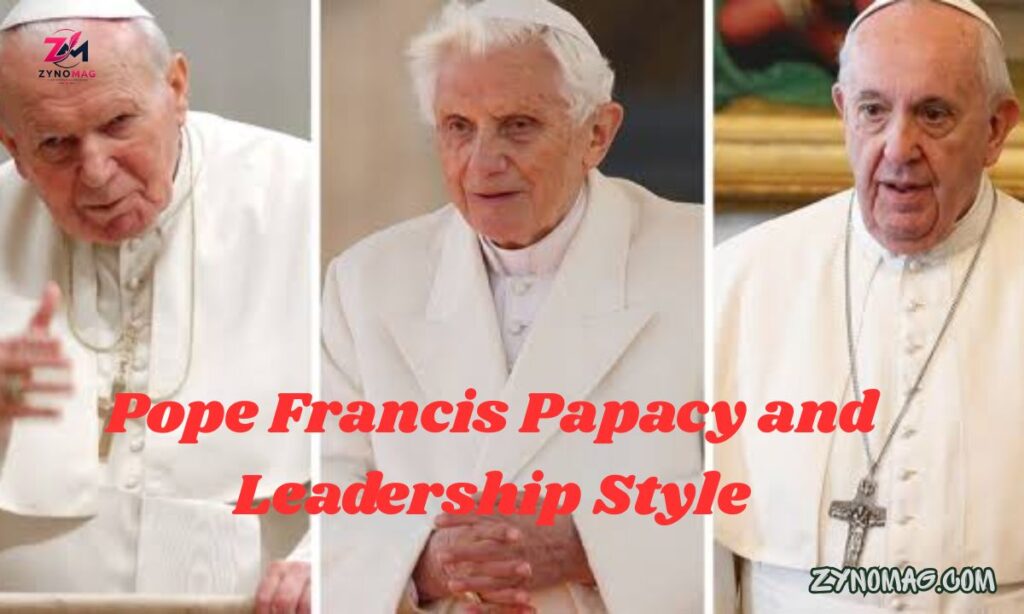
From the first day he showed a different tone. He asked the crowd to pray for him before he blessed them. He chose to live in the Vatican guesthouse, Casa Santa Marta, instead of the papal apartments.
His leadership style can be described in a few clear points:
- Simple and direct speech
- A focus on mercy and forgiveness
- Strong attention to migrants, the poor, and the elderly
- Calls for dialogue with other faiths
- A push for a more listening, more inclusive Church
Some of his major writings and actions include:
- Evangelii Gaudium (2013): a call for a joyful, outward-looking Church
- Laudato Si’ (2015): a letter on climate change and care for the planet
- Amoris Laetitia (2016): a document on family life
- Fratelli Tutti (2020): a letter on human fraternity and social friendship
- A 2013 visit to the island of Lampedusa to draw attention to migrants
His papacy was not free from disagreement. Some conservatives felt he moved too fast. Some reform-minded Catholics felt he moved too slowly. Critics also questioned how the Church handled abuse cases during his years. A fair biography has to include all of this.
Pope Francis Death and Funeral
In February 2025, Francis was admitted to a Rome hospital with a respiratory illness that developed into double pneumonia. He spent weeks in care, then returned to the Vatican to recover.
He made a brief public appearance on Easter Sunday. The next day, April 21, 2025, he died at the age of 88 at his residence in Vatican City. The Vatican said the cause was a stroke followed by irreversible heart failure.
His funeral was held on April 26, 2025, in St. Peter’s Square. World leaders and large crowds attended. His coffin was then carried through Rome to the Basilica of Santa Maria Maggiore.
He had asked to be buried there, not in St. Peter’s Basilica. His tomb is plain and carries a single word, “Franciscus.”
Important dates:
| Date | Event |
| February 2025 | Hospitalized with respiratory illness |
| April 20, 2025 | Easter Sunday appearance |
| April 21, 2025 | Death at age 88 |
| April 26, 2025 | Funeral and burial |
| May 8, 2025 | Cardinals elect Pope Leo XIV |
Is There a Connection Between Gene Hackman and Pope Francis?
No. There is no known personal, professional, or family link between Gene Hackman and Pope Francis. We found no reliable record of a meeting, a shared project, or any public statement between them.
The main reason the two names appear together is timing. Both died in 2025, and both appear on many “notable deaths of 2025” lists. That is a shared date in history, not a shared story.
It is better to say this clearly. Search results sometimes blur real facts with guesses, and readers deserve a straight answer. Still, a side-by-side look can be useful. It helps us see how two very different careers shaped public life.
Leadership, Humility, and Public Recognition
Both men earned respect in part through humility. Hackman rarely chased celebrity. He avoided the spotlight after he retired and lived quietly for many years. Francis made humility part of his public message.
He lived simply, spoke plainly, and asked for prayers instead of praise. Both also received huge public recognition. Hackman collected Oscars and lasting critical praise.
Francis drew huge crowds and was heard by leaders across many nations and faiths. The lesson is that quiet leadership can be strong. A person does not need a loud style to leave a large mark.
Gene Hackman and Pope Francis: Their Lasting Legacies
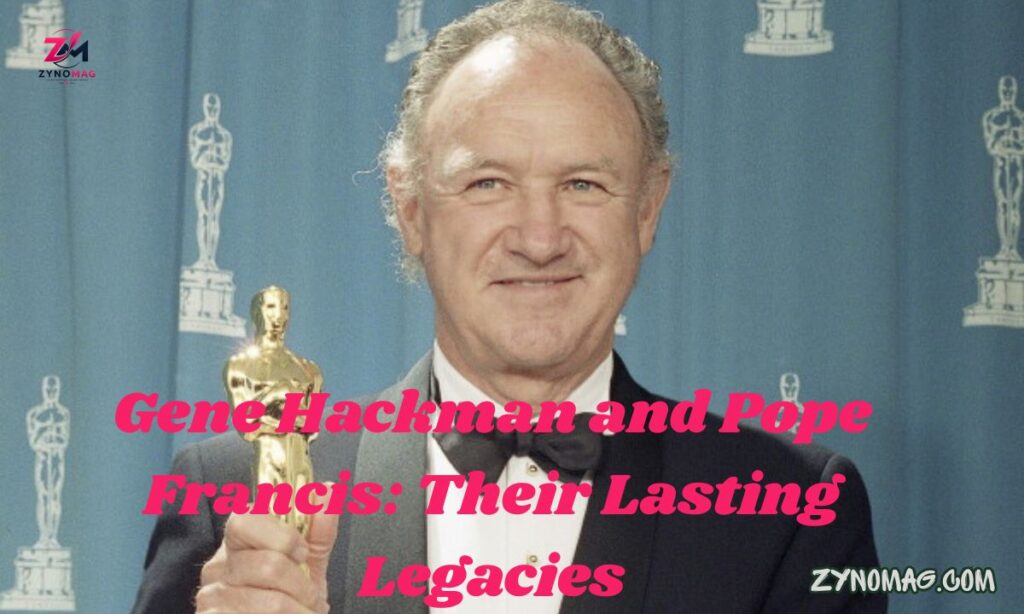
A legacy is what remains after a person is gone. For Hackman it is a body of film work that people will keep watching. For Francis it is a changed tone in the Church and a louder moral voice on social issues.
Hackman’s Contribution to Cinema
Hackman helped change what a screen actor could look like. He proved that an ordinary face with extraordinary skill could carry a film.
His lasting contributions include:
- Natural, unforced acting that made characters feel real
- A range that covered heroes, villains, and everything in between
- Strong performances in films that still shape the crime, sports, and drama genres
- A model for actors who value craft over fame
New viewers still find his films on streaming platforms and in film schools. That steady interest is the best sign of a lasting legacy.
Francis’s Contribution to Religion and Society
Francis changed how many people saw the papacy. He made the Church speak more about mercy, migration, poverty, and the environment.
His main contributions include:
- Putting care for the poor and migrants at the center of Church talk
- Raising climate change as a moral issue through Laudato Si’
- Encouraging dialogue with Muslims, Jews, and other faith leaders
- Starting a wider conversation in the Church about listening and shared decision making
His legacy is also debated. Supporters praise his warmth and courage. Critics point to unresolved tensions and uneven reform. History will keep weighing both views.
What Their Lives Teach About Success and Meaning
These two lives point to a few simple ideas.
- Late starts can work. Hackman found real success only after many hard years.
- Craft matters. Both men were known for doing their work with care.
- Humility builds trust. Neither relied on image alone.
- Influence is not only about fame. It is also about how you treat people and what you stand for.
- No life is only one thing. Each man had strong praise and fair criticism.
Success looked different for each of them. Meaning, however, came from the same source: serious commitment to a calling.
Frequently Asked Questions
Who were Gene Hackman and Pope Francis?
Gene Hackman was a two-time Oscar-winning American actor. Pope Francis was the Argentine-born head of the Catholic Church from 2013 to 2025.
Were Gene Hackman and Pope Francis connected?
No known personal or professional connection exists between them. They are linked mainly because both died in 2025.
When did Gene Hackman die?
Officials believe Gene Hackman died around February 18, 2025. He and his wife were found on February 26, 2025.
When did Pope Francis die?
Pope Francis died on April 21, 2025, which was Easter Monday. He was 88.
What were Gene Hackman’s most famous movies?
His best-known films include The French Connection, Unforgiven, Hoosiers, The Conversation, Superman, and The Royal Tenenbaums.
Why was Pope Francis historically significant?
He was the first Jesuit and the first Latin American pope. He also made mercy, migrants, and climate care major themes of his papacy.
Did Gene Hackman win Academy Awards?
Yes. He won Best Actor for The French Connection and Best Supporting Actor for Unforgiven.
What were Pope Francis’s main priorities?
His main priorities were mercy, care for the poor, migrants, peace, interfaith dialogue, and protecting the environment.
Why are Gene Hackman and Pope Francis still remembered?
Hackman is remembered for lasting film performances. Francis is remembered for his humble style and his moral voice on global issues.
What can people learn from comparing their lives?
They show that careful work, humility, and a clear sense of purpose can leave a lasting mark in very different fields.
Conclusion
Gene Hackman and Pope Francis never shared a stage, a project, or a public story. Their names meet only in the history of 2025, the year the world said goodbye to both. Still, a careful look at their lives shows real lessons.
One man turned hard beginnings into some of the most trusted performances in film. The other turned a quiet Jesuit life into a global voice for mercy and care. Their legacies are different, and they should be judged on their own terms.
Hackman’s work lives on screen, and Francis’s influence lives in the Church and in public debate. Whether you come for the biography, the milestones, or the lessons, the common thread is simple. Serious work, done with honesty and humility, tends to outlast the person who did it.